
Disclosure: This review contains affiliate links. I may earn a commission if you buy through them, at no extra cost to you. Written by Michael Montoya. Last updated: November 7, 2026.
Sore feet at the end of a long day are miserable, and numb or burning feet are worse. When you’re dealing with that, a small mat that promises relief in 15 minutes is hard to scroll past.
TheraFoot Pro’s pages go well past relief. They say it can “eliminate your pain for good in less than 30 days,” that it can help neuropathy, and on some pages even that it “Effectively Manages High Blood Pressure.” That’s a lot to ask of a foot pad.
So I read its offer pages, sales stories, return policy, and the abstracts of the two papers its ads cite, along with what the FDA and the National Institutes of Health say about these devices and these conditions. I wanted to know what you’d really be buying.

A foldable electrical foot massager with simple controls. It’s a fair cheap treat for tired feet, but the medical promises on its sales pages go far beyond any evidence I could find.
- Starts at $49.99 before shipping
- Wireless and rechargeable
- 8 modes and 19 levels, with simple controls
- No pills or creams
- No study on this device that I could find
- I couldn’t confirm FDA clearance
- Refund terms conflict across its pages
- Numb feet and implanted devices need a doctor’s OK
- Not a treatment for neuropathy, edema, or lymphedema
Quick Verdict
TheraFoot Pro looks like a low-cost electrical foot massager, and at about $56 with shipping it may be a pleasant way to rest tired feet. I wouldn’t buy it to treat neuropathy, edema, or lymphedema. I found no study on this device, I couldn’t confirm any FDA clearance, and its pages disagree about the refund window. If your feet are numb or your legs are swollen, get that looked at first.
What is TheraFoot?
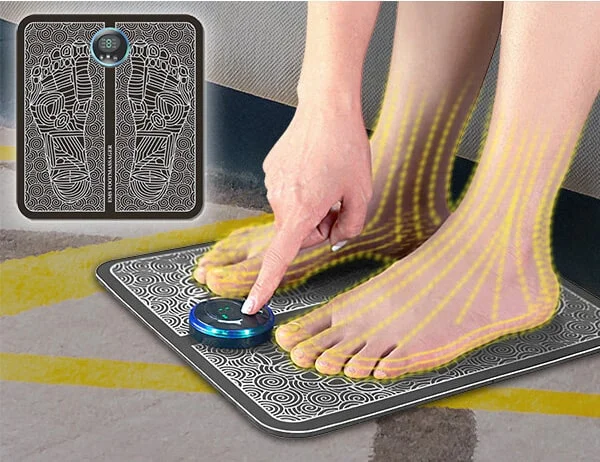
TheraFoot Pro is a thin, foldable pad with a small round controller that clips on. You put your bare feet on it, pick a setting, and it sends electrical pulses into your feet and calves for about 15 minutes.

The technology is called EMS, for Electrical Muscle Stimulation. The brand also uses the name NMES, for neuromuscular electrical stimulation. The idea is that the pulses make your muscles contract without you having to move them.
The brand says it’s “owned and operated in the beautiful city of San Diego, California.” Its contact page lists a Wyoming address and an email at onlinedirectdeals.com, and its privacy policy names Online Direct Deals in Roseville, California. That isn’t a scandal, but it does make it harder to say who’s behind it.
Its pages also say it was “designed by a renowned podiatrist.” No page I read names that podiatrist, so I give that line no weight.
Key Features and Specifications of TheraFoot Pro
The offer page lists these specs, with my notes where needed.

Massage Settings
The offer page lists “8 Massage Modes With 19 levels of intensity.” That gives you plenty of room to start low, though a buyer comment on a sales story mentions different numbers, so go by the box. If your feet have reduced feeling, a big range is less of a plus, for reasons I’ll get to.
EMS Pulses
This is what separates it from a vibrating or rolling massager. It works through electrical current on your skin, so expect to notice the pulses.
Wireless And Rechargeable
The offer page says “Wireless and Rechargeable No batteries or tangled cords.” There’s a charger in the box, but I didn’t see a battery life listed.
Simple Controls
It has a “Clear Digital Screen and Easy 3-Button Control.” Three buttons is simple, which helps if you don’t want an app.
Foldable Design
The controller attaches to the mat, and the brand calls the set “Foldable,” with a “High Quality Travel Box” in the package. It should be easy to store or bring along.
What’s In The Box
The list is one foldable pad, one EMS device, a charger, a user guide, and a travel box. It doesn’t list any gel or replacement parts, and the guide isn’t on the pages I read.
How TheraFoot Pro Works
The brand’s explanation runs in a few steps, and I checked each one.

Pulses Reach Your Muscles
Electrical stimulation can make muscles contract. That’s well established, and it’s used in rehab. The FDA says most of the devices it has reviewed are “intended for use in physical therapy and rehabilitation under the direction of a health care professional.” That’s a different setting from a mat on your living room floor.
Blood Flow Goes Up
The brand says it’ll “jumpstart” your natural blood flow. Muscle contractions in the calf do help move blood, so the idea makes sense. What I couldn’t find is any measurement of what this pad, working through your soles, does for blood flow.
“More Oxygen” To Your Nerves
This is the brand’s central claim: that it solves “the #1 root cause of chronic foot and leg pain: It gives your nerves more oxygen!” I found no source for that as a root cause, and foot and leg pain has many causes. One of its own sales stories lists diabetes, chemo, and autoimmune conditions as reasons for neuropathy, and a mat doesn’t address any of them.
Moving Fluid And Reducing Swelling
There’s some real research here. A 2019 systematic review cited in its ads found 7 studies, and six supported this kind of stimulation for reducing swelling. Those were “rehabilitation settings,” and the authors say “further trials are needed.” It didn’t test this product.
What About Fast Relief?
Several of its offer pages say “96.6% of users experience immediate relief!” They give no source or method, so I can’t tell you who was asked or what they were asked.
What You’re Signing Up For With TheraFoot Pro
The routine is short. The brand makes claims for a first month, and this is what I’d expect.
First Sessions
The brand’s steps are “Attach operator device and turn on,” then “Place both feet on mat and choose mode.” Start at the lowest level, since the pulsing may be strange at first. Stop if anything hurts or stings.
The First Two Weeks
What you’re testing here is easy to answer: is it comfortable, and do you look forward to it? Micah P., quoted on its page, writes about feeling “rejuvenated” after about a week. A relaxing routine is a fair reason to buy one.
Weeks Three And Four
The sales page says it can “eliminate your pain for good in less than 30 days.” I can’t back that up, and I’d be surprised if a foot pad could do it for most people. Write down your pain and swelling each week, and judge it by that, not by the ads.
Your Refund Clock
The advertised window is 90 days, but the return policy on the brand’s other site points to 60 days and “unused” items, as I explain below. So work out your deadline on day one. Once you’ve used it, the return may not be simple.
If You’re Not Improving
Don’t keep at it for months hoping it’ll turn around. Persistent pain, swelling, numbness, or tingling deserves a diagnosis, because the cause decides the treatment.
Pros and Cons
Based on what I could check:
Who Can Benefit From TheraFoot Pro?
I’d keep this list short. The brand’s pages speak to almost everyone with foot trouble, and that’s where I’d slow down.

It may suit you if you:
- Have ordinary tired feet after a long day on them, with normal feeling
- Want a cheap massager to try at home
- Can absorb the cost if you don’t like it
Talk to your doctor first, or skip it, if you have any of these:
- Neuropathy or numb feet: The National Institutes of Health warns, “When you lose feeling in your feet, you may not feel a pebble inside your sock or a blister on your foot, which can lead to cuts and sores.” The same goes for stimulation you can’t feel properly, so check your feet after each session.
- Diabetes with foot sores: Call your provider about “a cut, blister, or bruise on your foot that does not start to heal after a few days.” Don’t use a device on broken skin.
- A pacemaker or defibrillator: The FDA notes “interference with implanted devices such as pacemakers and defibrillators.” Don’t use it without your cardiologist’s OK.
- Edema: MedlinePlus lists “Heart failure,” “Kidney disease,” and “Pregnancy” among the causes. Those need a doctor, not a massager.
- Lymphedema: MedlinePlus says treatment includes “exercise, compression devices, skin care, and massage,” and that massage isn’t this electrical mat. The American Cancer Society says to “Find a certified lymphedema therapist.” Ask yours before you add this.
- A past or known blood clot: Ask your doctor before you use anything that makes your calf muscles contract.
- Pregnancy, recent surgery, or a recent leg injury: I found no safety guidance for you on its pages, so ask first.
Don’t use it, and get medical care right away, if one leg is suddenly swollen, warm, red, or painful. Those can be signs of a blood clot. The National Heart, Lung, and Blood Institute says, “A pulmonary embolism can cause sudden chest pain and shortness of breath.” For those symptoms, call 911.
How to Use TheraFoot Pro (Step-by-Step Guide)
The offer page gives only three short steps, so most of this is my own caution. Follow the guide in your box if it differs.

Step 1: Check Your Feet
Look for cuts, blisters, or sores before you start. If you find any, skip the session.
Step 2: Charge It And Attach The Controller
Charge it fully, then attach the controller to the pad.
Step 3: Sit Down
Sit in a chair, with the pad flat on the floor. Brand images show people doing it this way.
Step 4: Put Your Bare Feet On The Pad
The brand’s images show bare feet. Dry feet and a clean pad are a sensible habit.
Step 5: Choose A Mode
Pick one of the 8 modes, starting with the gentlest you can find.
Step 6: Start At The Lowest Level
Increase slowly, and stop at a level that’s comfortable. If your feet are numb, don’t turn it up to chase a sensation.
Step 7: Use It For 15 Minutes
The brand says “15 minutes a day.” I wouldn’t go past that without advice.
Step 8: Check Your Feet Again
Look for redness or irritation afterward. The FDA says people have reported “shocks, burns, bruising, skin irritation, and pain” with muscle stimulators in general, so don’t ignore anything unusual.
Benefits of Using TheraFoot Pro
Here are the benefits the brand lists, with how far I’d trust each one.
- “Instant Relief”: Some people may find it soothing quickly. I found no measurement behind this, including the 96.6% figure.
- Reduced swelling: This has the most research behind the idea. It isn’t a reason to try it on unexplained swelling.
- Better blood flow: The idea makes sense, but I saw no measurement for this device.
- Relief from neuropathy: One buyer, Joyce G., says it “makes my neuropathy easier to deal with.” One PubMed search I ran for foot massage device trials on neuropathy returned nothing, so I can’t go further than that buyer’s word.
- “Effectively Manages High Blood Pressure”: I found no evidence for this, and I wouldn’t believe it. Don’t change anything about your blood pressure care because of a foot mat.
- One-time cost: True as far as I can see, with no refills listed. I didn’t find a warranty term on the pages I read, so ask about it.
Comparing TheraFoot Pro With Other Solutions
The brand’s comparison chart puts it against surgery and pills, and it wins every row. I’d look at it differently.

Painkillers And Prescriptions
Medicine and a massager do different jobs. The offer page calls it “The Safer, Healthier Choice,” but your doctor may have prescribed something for a condition a mat can’t treat. Don’t stop anything without asking.
Massage Therapy
A massage therapist costs more per session, so the mat costs less than a therapist before long. But the brand’s “your own massage therapist” comparison is a stretch, since electrical pulses aren’t the same as hands on your feet.
Compression
MedlinePlus lists compression devices as part of lymphedema treatment. If a clinician prescribed compression, keep doing it, and treat a foot mat as something extra at most.
A Podiatrist
The offer page says it’ll save you from “expensive podiatrists and massage therapists.” For sore feet with no other problem, maybe. For numbness, sores, or swelling, you want the podiatrist, because they can find the cause.
What The Sales Stories Tell You
You’ll probably reach this product through one of its long sales stories, so it’s worth knowing how to read them.
The Nurse Story
One story is by a “Barbara Ellis,” described as a nurse from a podiatry clinic. It says she went from “elephant legs” and a wheelchair to rarely needing one, after her old podiatrist recommended the mat. It’s moving, and it’s built to be. At the bottom, the page says, “THIS IS AN ADVERTISEMENT AND NOT AN ACTUAL NEWS ARTICLE,” and it calls the results “illustrative.” I’d read every detail with that in mind.
The Podiatrist Stories
Three more stories have nearly the same headline, “Top Podiatrists Agree,” swapped between neuropathy, edema, and lymphedema. The same mat is the answer to all three, and these conditions don’t share one cause. Edema can come from heart failure or kidney disease, and neuropathy from diabetes or chemo. If you have one of them, ask yourself why a single foot pad would suit each one.
The Home Page Story
The brand’s home page runs a first-person story that mentions “clinical trials” and says the technology “Reverses Neuropathy in Mere Weeks.” It names no trial. Its fine print says the story is “used solely for advertising purposes” and that the people shown are models.
What The Papers Really Say
The ads cite two papers, and I’m glad they do, because you can check them. The swelling review looks at people in rehabilitation, not at a consumer mat. The muscle paper reports that stimulation can raise muscle mass by “around 1%” and function by “around 10–15%” after 5–6 weeks, and it says this “should not be regarded as a replacement of exercise training.” Neither abstract mentions TheraFoot. If you can walk, a daily walk is still worth more of your attention than this mat.
What To Ask Before You Pay
- Which return window applies to the order, and does a used device still qualify?
- Has this model been cleared by the FDA, and what’s the number?
- Which company sells it, and where do returns go?
- What does the user guide say about pacemakers, pregnancy, and numb feet?
How they answer tells you a lot about who you’re buying from.
TheraFoot Pro Claims Vs What I Found
| Claim | What I found | Where I checked |
| “it can even eliminate your pain for good in less than 30 days” | I found no study or measurement showing this. The sales page gives no source. | Offer page |
| “clinically proven” | The two papers its ads cite are about the technology. One is a review on swelling in rehab settings, and the other is about building muscle. Going by their abstracts, neither tests this mat, or neuropathy. | Sales story, both papers |
| “100% Safe & Natural” | The FDA’s 2017 page calls muscle stimulators devices and lists reports of shocks, burns, and interference with pacemakers. The muscle paper calls EMS safe in general, but “100%” goes too far, and an electrical device isn’t “natural,” either. | Offer page, FDA |
| “Effectively Manages High Blood Pressure” | I found nothing supporting this. It’s the line on the page I’d trust least. | Other offer pages |
| “TheraFoot Pro GUARANTEES Relief From Neuropathy” | Nothing can promise that, and it’s from a page labeled “THIS IS AN ADVERTISEMENT AND NOT AN ACTUAL NEWS ARTICLE.” Its results are described as “illustrative.” | Sales story |
| “Podiatrists are lining up at sold-out medical conferences” | No conference or doctor is named. I read this as sales copy. | Sales story |
| “90-Day, No-Questions Asked, Money Back Guarantee” | The return policy on therafootpro.com says “within 60 days of purchase” and “unused,” and the data behind the offer page shows a 30-day return setting. I couldn’t read a separate policy for the offer page itself. | Offer page, return policy |
What Buyers Say On Its Page
These come from the brand’s own offer page, so they’re its picks, and I can’t verify them. Its offer page shows “4.8 stars” from “(1,897)” reviews with no source given, but I found no Trustpilot profile at therafootpro.com, and BBB searches for the name returned nothing.
Two who liked it:
Micah P. wrote, “I’ve been using it for about a week now and I am noticing a difference. My feet and legs feel more rejuvenated in the morning after using it at night.”
Sam C. wrote, “Bought this for my wife since she complains about foot pain often and ever since she started using it she can notice a lot less pain in her feet so I’m happy with it and she is too.”
And one with a practical routine:
Donna M. wrote, “I use it every morning, 15 minutes and I’m great for the day.” If you buy it, her short, fixed routine is about the right idea.
Price of TheraFoot Pro
These are the prices I saw on the offer page my links go to, on November 7, 2026.
| Option | Total | Units | Per unit |
| One device | $49.99 | 1 | $49.99 |
| Buy 2, Get 1 Free | $119.98 | 3 | About $39.99 |
| Buy 3, Get 2 FREE | $179.97 | 5 | About $35.99 |
The per-unit numbers are my math. The offer page says “Free Shipping On All Bundles,” and its data lists $5.99 US shipping on the single device, which would make that $55.98. Check the total at checkout. The bundle prices use a $59.99 list price, not the $49.99 single price, and prices may differ between its offer pages.
Most people need only one. I’d buy the single device first, because if you don’t like it, a bundle leaves you with more to send back at your own shipping cost.
Where to Buy?
My links go to the brand’s offer page. Its other offer pages say buying there is “buying directly from Therafoot Pro.”
The sales story warns that copies have “components” that are “cheap and possibly dangerous” and says to order only from the official site. The same story is selling you the product, so it isn’t a neutral warning. The design in the brand’s images looks like a type of EMS mat that’s widely sold, so compare before you buy. Wherever you buy, get the return terms first.
The return policy on the brand’s other site says:
- You can return it “within 60 days of purchase less shipping and handling (if applicable).”
- “your item must be unused, in the same condition that you received it, and it must also be in the original packaging.”
- “You will be responsible for paying for your own shipping costs for returning your item.”
That’s a long way from a 90-day guarantee that lets you “use it for 90 days, and then decide.” I can’t tell you which applies to your order. Email support@therafootpro.com (the offer pages’ address) or Support@onlinedirectdeals.com (the return policy’s address) before you buy, and keep the reply.
Frequently Asked Questions
Is TheraFoot Pro FDA Cleared?
I couldn’t confirm that. The pages I read don’t claim it, my attempt to search the FDA’s device database didn’t give a clear result, and the FDA says muscle stimulators are medical devices. Ask the company for the clearance number.
Can It Help Neuropathy?
I found no study showing it does. One buyer on its page says it helps, but numb feet need the most care, so talk to your doctor first.
Do You Use It With Socks Or Barefoot?
Brand images show bare feet, and the pulses work through contact with your skin. Check your guide, and don’t use it on broken skin.
Can You Travel With It?
The brand calls it “Sleek, Portable,” and it comes with a travel box.
Can More Than One Person Use It?
I saw nothing against it, though I’d wipe it down between people. Anyone with the conditions above should ask their doctor first.
How Long Should You Use It Each Day?
The brand says 15 minutes a day. If you get skin irritation or more pain, stop and get it checked.
Final Verdict: Should You Buy It?
Yes, if you have ordinary tired feet, normal feeling in them, and you’d like a cheap electrical massager to try. No, if you’re hoping it’ll treat neuropathy, swelling, or lymphedema. I gave it 8.0 out of 10 for the low price and easy controls; the missing evidence and conflicting refund terms are why it isn’t higher. See a doctor first about any numbness, sores, or one-sided swelling.


