
Disclosure: This review contains affiliate links. I may earn a commission if you buy through them, at no extra cost to you. Written by Michael Montoya. Last updated: November 8, 2026.
Electrolyte drinks have taken over the hydration aisle, and most of them come with sugar, sweeteners, or a taste like something from a candy store. If you’ve started reading labels, you may have wondered whether there’s a simpler way to get the minerals you lose in sweat.
Seaonic’s answer is filtered seawater in a sachet. Its site says it’s “Cold-microfiltered Atlantic seawater with up to 78 naturally occurring minerals and trace elements. Nothing added.” I wanted the plain facts: what’s in each sachet, how much sodium it carries, what the brand claims, what it costs, and how the refund policy works.
I went through Seaonic’s home page, product page, FAQ page, and its refund and shipping policies. I checked Trustpilot and the BBB, and I read the FDA’s guidance on sodium, since sodium is the main mineral in seawater.

Filtered Atlantic seawater in single sachets, in a stronger Hypertonic and a milder Isotonic version. Clean and simple, but pricey for what is mostly salt, and opened boxes can't be returned.
- One ingredient, no sugar or sweeteners
- Main minerals listed per sachet
- Batch tested, COAs on request
- Two strengths
- Trustpilot 4.3 from 77 reviews
- About $1.50 to $2.00 per sachet
- No refunds on opened boxes
- Mostly salt
- US shipping only
- No BBB profile found
Quick Verdict On Seaonic
Seaonic is a clean, one-ingredient electrolyte: filtered Atlantic seawater, with no sugar, flavors or sweeteners. Its Trustpilot score is 4.3 from 77 reviews, the brand lists the main minerals per sachet, and it says every batch is third-party tested. If you want electrolytes without additives, its ingredient list matches what the label describes.
The catch is the price and the refund policy. On subscription, the product page lists $179.99 a month for 120 sachets, and the refund policy only covers unused, unopened products, and not items bought on sale or with a discount code. The minerals are also modest apart from sodium and chloride, so I’d treat Seaonic as a convenient, additive-free way to take in some salt and minerals, not an answer to tiredness, poor sleep or brain fog.
What is Seaonic?
Seaonic is a liquid electrolyte supplement made from seawater. The FAQ on its home page says it’s “cold-microfiltered Atlantic seawater from phytoplankton vortexes in the Bay of Biscay, off the coast of France and Spain,” and that “It’s purified and packaged, nothing added.”

It comes in two strengths. Hypertonic, the brand’s “ACTIVATE” formula, is “100% seawater, cold-microfiltered” at 33 grams per liter, which the FAQ calls “natural seawater salinity, more concentrated than blood plasma.” Isotonic, the “RESTORE” formula, is “Seawater + spring water, 9 g/L,” which the brand says is “diluted with spring water to match the mineral concentration of your blood plasma.”
It’s meant to be taken neat. The product page’s directions say “1–6 sachets a day,” torn open and drunk with nothing mixed in. The brand suggests Hypertonic earlier in the day and Isotonic later.
Like any supplement, it carries the standard line: “These statements have not been evaluated by the Food and Drug Administration. This product is not intended to diagnose, treat, cure, or prevent any disease.”
What’s Inside Seaonic? (Ingredients)
The ingredient list is about as short as it gets. Here’s what the brand’s pages say is in each sachet, and what I make of it.
One Ingredient: Filtered Seawater
The product page lists “Purified Atlantic seawater. Nothing else.” for Hypertonic, while Isotonic adds spring water. The brand says the water is cold-microfiltered, and its home page describes “0.22 μm filtration” that “removes unwanted particles without heat or chemicals.”
The FAQ says the water is “collected from the Bay of Biscay at 30–50 m deep” and “third-party tested across 100+ quality parameters before every batch is released.” Its testing answer lists “microbes, chemical composition, heavy metals (lead, cadmium, mercury, arsenic) and microplastics,” and says “COAs are available on request.” I didn’t request a certificate of analysis, so I can’t confirm the results myself; if purity matters to you, ask for the COA for your batch.
The Main Minerals Per Sachet
The “up to 78” figure gets most of the attention, but the product page’s Composition tab gives the amounts that matter. Per Hypertonic sachet, it lists:
- Chloride: 198 mg
- Sodium: 102 mg
- Magnesium: 11 mg
- Calcium: 4.8 mg
- Potassium: 4.8 mg
- Trace elements: “+ 60 trace elements, including zinc, selenium, iodine and boron.”
The page adds, “Isotonic: same spectrum, lower concentration,” but doesn’t give separate amounts for it. In plain terms, this is mostly salt. The 102 mg of sodium is about 4% of the FDA’s Daily Value for sodium, and the magnesium, calcium and potassium are small amounts. The trace elements are present, but the page doesn’t say how much of each.
What Isn’t In It
The FAQ says, “Zero carbs, zero sugar, zero sweeteners, zero flavours, zero additives.” The product page also lists it as keto, paleo, carnivore, fasting and vegan friendly, and gluten-free. That’s where Seaonic stands out: if you avoid sugar or sweeteners, or you follow a strict diet, there’s nothing here to break it.
The earlier version of this review also listed vitamins, amino acids and enzymes in the water. None of the brand’s current pages list those, so I’ve left them out.
What Comes In The Box
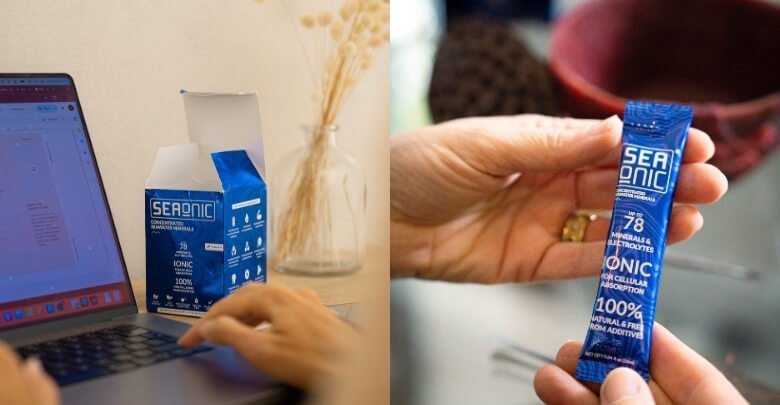
Seaonic comes as boxes of individually sealed sachets, and the brand’s pages describe the packaging in a few parts.
Individually Sealed Sachets
Each dose is its own sachet. The home page calls them “Pharma-Grade Sachets,” “Individually sealed to protect product integrity.” There’s no scoop, no tub, and nothing to measure.
What The Sachet Is Made Of
The FAQ says the sachets use “A pharmaceutical-grade inner film certified for zero leaching, no microplastics, and no chemical interaction.” It doesn’t name the certification or the body that issued it. One review shown on the brand’s home page mentions worrying about “contamination of microplastics from the liner of the plastic packs,” so it’s a question buyers do raise.
No Mixing Needed
The FAQ’s directions are short: “Tear. Drink. Take it neat, straight from the sachet.” That makes it easy to carry in a bag or gym kit.
Packs Of Two Formulas
The bundles on the product page mix both formulas: 60 sachets as “30 Hypertonic + 30 Isotonic,” or 120 sachets as “60 Hypertonic + 60 Isotonic.” When I selected a single formula, the bundle shown still read “60 Hypertonic + 60 Isotonic,” so if you only want one strength, ask the brand before ordering.
What The Brand Says It Does Over Time
 The printing on the sachet in this image doesn’t match the brand’s real packaging, so treat it as an illustration.
The earlier version of this review described a year of personal results, from better sleep to stronger nails. I’ve replaced that with what the brand itself claims, since that’s what I can check.
Hydration And Muscle Function
The FAQ says Seaonic supports “normal muscle function and providing what your body needs for recovery,” because “Sweat depletes far more than just sodium.” That’s a reasonable claim for any electrolyte. It doesn’t show that Seaonic works better than other salt-based drinks.
Energy And Fatigue
Asked about fatigue, the FAQ says, “Cellular energy production depends on mineral balance.” It adds that Seaonic “replenishes the full spectrum of ionic minerals your cells need,” and the home page shows a customer quote about “steady energy.” Note that none of this shows an energy boost in people who aren’t low on minerals.
Focus And Stress
This is the brand’s most honest answer. The FAQ says, “Seaonic does not directly enhance cognitive function.” It adds that electrolyte depletion can affect concentration, and “If depletion was the obstacle, removing it lets your body do the rest.” I’d take that at face value: if you’re not depleted, don’t expect sharper focus.
Sleep, Skin, Hair And Colds
Older copies of this page promised better sleep, healthier skin, stronger nails, thicker hair and fewer colds. The brand’s current pages don’t promise those benefits, and I found nothing behind them, so I dropped those claims.
Pros and Cons
Here’s how it weighs up, based on the brand’s pages, its policies and independent reviews.
How To Take It (Daily Dosage)

The brand’s directions are flexible, which is handy, but the range is wide.
One To Six Sachets A Day
The product page’s directions say “1–6 sachets a day.” That’s a wide range. At the top end, six Hypertonic sachets would add about 612 mg of sodium, so it’s worth counting if you watch your salt.
Hypertonic Earlier, Isotonic Later
The page’s tip is “Hypertonic earlier in the day, Isotonic later.” The FAQ suggests Hypertonic for “morning, or before and during exercise,” and Isotonic “any time of day.”
For Active Days
For active people, the FAQ suggests “Two sachets daily,” with Hypertonic in the morning or before a workout and Isotonic later in the day.
On An Empty Stomach, Per The Brand
The FAQ says, “For best absorption, take either format on an empty stomach,” ideally 30 minutes before a meal or 90 minutes after. It doesn’t cite a source for the absorption claim.
Straight From The Sachet, Mostly
The brand says, “Don’t mix it with water,” but also says that if the taste is strong at first, “you can mix it with a small amount of water to start.” Mixing it into coffee or a smoothie is “not ideal,” per the FAQ.
What Does Science Say About Seaonic?
Seaonic doesn’t promise much about what it does, and the evidence behind it is thin as well.
No Study Of Seaonic Itself
None of Seaonic’s pages point to a trial of the product itself. The home page talks about testing for purity, not about trials of what it does in the body.
The Studies In The Earlier Version
The earlier version of this review cited a 19th-century French physiologist who used seawater in hospitals, and three studies on deep ocean water, runners in the heat, and heart health in animals. I couldn’t trace those details to a source I could read, and none of them tested Seaonic, so I’ve removed them.
Sodium Is The Main Active Mineral
Chloride is the larger number, but sodium is the one that matters for health, so the FDA’s guidance is the most useful context. It says, “The Daily Value for sodium is less than 2,300 milligrams (mg) per day,” and that “Diets higher in sodium are associated with an increased risk of developing high blood pressure.” One sachet’s 102 mg is small on its own, but it adds to everything else you eat.
The Absorption Claim
The FAQ says its minerals are “already ionic and ready for uptake,” and that “1,000mg of sodium chloride only delivers approximately 390mg of absorbable sodium.” I couldn’t find support for the idea that the sodium in table salt is less absorbable. The FDA simply describes table salt as sodium chloride, with sodium “one of the chemical elements found in salt,” so I’d compare sodium per serving across products rather than take the brand’s word for it.
Is Seaonic Safe for Everyone?
For most healthy adults, a sachet of filtered seawater is a small dose of salt. A few groups should check first.
Purity Testing
The FAQ says Seaonic is “third-party tested across 100+ quality parameters before every batch is released,” and claims “No microplastics. No heavy metals. No pathogens.” Those are the brand’s statements. The FAQ itself admits “Raw ocean water isn’t” safe to drink, so I’d ask for the batch COA if you plan to take it daily.
High Blood Pressure Or Salt Sensitivity
The FAQ says, “Please check with your healthcare professional before use. If you have high blood pressure or salt sensitivity, we suggest starting with Isotonic.” The FDA explains that “a high-sodium diet draws water into the bloodstream, which can increase the volume of blood and subsequently your blood pressure.” An older line here said it won’t raise blood pressure the way table salt does. I couldn’t find support for that, so I removed it.
Pregnancy, Breastfeeding And Medical Conditions
The FAQ says to “check with your healthcare professional before use during pregnancy or breastfeeding,” and before use “if you have a medical condition or take medication.” That’s sensible for anyone on a low-sodium diet or with kidney or heart problems.
Allergens And Diets
With one ingredient, there’s little to react to. The product page lists it as gluten-free and vegan friendly, with no sugar or additives.
Who Should Try Seaonic?
Based on the brand’s pages and the safety notes above, here’s who I think it suits, and who should skip it:
- People who avoid sugar and sweeteners: there’s nothing in it but seawater, and spring water in the Isotonic version.
- People on strict diets: the brand says it fits keto, paleo, carnivore and fasting.
- People who want a little sodium without sugar: the FDA calls “5% DV or less of sodium per serving” low, and one sachet is about 4%, so heavy sweaters may need more than one.
- Travelers and gym-goers: sealed sachets, no mixing.
- Not for anyone on a low-sodium diet without a doctor’s OK: each Hypertonic sachet adds 102 mg of sodium, and the directions allow up to six.
- Buyers outside the US, check first: the FAQ says, “We currently ship within the US only,” while the shipping policy says, “We offer international shipping to selected countries.”
- Not for kids or pets without advice: the brand’s pages don’t cover children or animals, so I’d ask a pediatrician or vet.
Comparison With Other Electrolytes

The brand’s own comparison chart sets Seaonic against “TYPICAL POWDERS” and “TYPICAL DROPS & CONCENTRATES,” with checkmarks for things like “Broad mineral spectrum” and “Third-party tested.” It names no rival products, so I can’t check it. The FAQ also says most electrolytes are “8–12 isolated ingredients assembled to deliver just 3–4 minerals,” which is the brand’s description, not a test.
Instead, here’s what Seaonic’s own pages say, next to what I’d check on any other electrolyte before buying.
| What to check | Seaonic | What to look for on a rival |
| Sodium per serving | 102 mg per Hypertonic sachet | Sodium per serving, especially if you sweat heavily |
| Potassium and magnesium | 4.8 mg and 11 mg | Whether these are listed, and how much |
| Sugar and sweeteners | None | Sugar, sweeteners, flavors or dyes |
| Form | Liquid sachet, no mixing | Powder, tablet or drops, and what you mix it with |
| Testing | Third-party tested, COAs on request, per the brand | Whether test results are published or available |
| Taste | “Salty,” per the FAQ | Flavor, if you need it to drink enough |
| Price per serving | $1.50 to $2.00 per sachet | Price per serving, not per box |
| Refunds | Unused, unopened products only | Whether opened products can be returned |
If you just want sodium without sugar, a plain unflavored electrolyte may cost less per serving. Seaonic’s draw is the single-ingredient approach, and it charges for it.
Testimonials From Other Users
This page used to quote five customers by name. I couldn’t trace any of those quotes, so they no longer appear here.
Here’s what I could check. On Trustpilot, Seaonic has a TrustScore of 4.3 from 77 reviews. The profile was claimed in March 2025, and Trustpilot says the company “Replied to 100% of negative reviews.” Five-star reviews make up 81%, and one-star reviews 5%.
Hector Castro wrote in September 2026, “Seaonic works great! With different hydration products that i have tried.” The complaints are about shipping and price. One one-star reviewer, posting as Annoyed in September 2026, called it an “Overpriced scam.” Brenda Cowan wrote in December 2025, “Shipping takes weeks, but the product is worth it,” which doesn’t match the FAQ’s 2-5 days. Steven Messler wrote in July 2026, “Product never delivered. Customer service is lacking. Still waiting for a credit,” and the company later refunded him. Craig Seitz, who left four stars in July 2026, wrote, “I’m not sure what this & similar products are so supposed to do for me.” That last one is a fair question for any electrolyte.
What’s the Price of Seaonic?
The prices in the earlier version of this review are out of date. These are the prices the product page showed in November 2026 for the two-formula bundles.
On subscription, billed every 30 days, 60 sachets (30 of each formula) cost $99.99, or about $1.67 a sachet, and 120 sachets (60 of each) cost $179.99, or $1.50 a sachet. The page lists “Free shipping” and “Pause, skip or cancel anytime” for subscriptions.
As a one-time purchase, the same bundles cost $119.99 for 60 sachets ($2.00 each) and $199.99 for 120 sachets ($1.67 each). The page’s “Save” figures compare against list prices of $139.98 and $279.96. The FAQ says orders over $100 ship free.
The guarantee needs a careful read. The product page shows “30-day money-back guarantee” next to each subscription option. But the refund policy says the item “must be unused, unopened, and in its original packaging,” and that “Opened or used products” and “Items purchased on sale or with a discount code” can’t be returned. Return shipping is on you unless the item was damaged or wrong. So in practice, if you open a box and don’t like it, the policy doesn’t promise a refund.
Where to Buy?
The FAQ says, “Currently, we operate exclusively online.” The brand’s own site is where the subscription terms and the refund policy apply. A Google AI answer for this product listed other sellers too, which I didn’t check, so I can’t say what terms apply there.
If you subscribe, note the renewal date. One Trustpilot reviewer asked for “a 3 day reminder before renewal,” and the pages I read don’t mention one. The FAQ says you can contact info@seaonic.com and that “A human answers within one business day.”
Is Seaonic Legit?
Yes, it’s a genuine product with paying customers behind it. Its Trustpilot profile shows 4.3 out of 5 from 77 reviews, and the company replies to negative reviews. The brand publishes its refund, shipping and FAQ pages, and lists the main minerals per sachet.
There are gaps. A BBB search for “Seaonic” returned “No results,” and the pages I read don’t give a company address. The FAQ also says “we offer free returns” in one answer, while its return answer says “shipping costs are at the customer’s expense.” The wording is unclear rather than contradictory, and it’s worth knowing, not a reason to call it a scam.
Claims Vs What I Found
| Brand claim | What I found |
| “up to 78 naturally occurring minerals and trace elements” | The product page gives amounts for five minerals; the other trace elements have no amounts listed. |
| “Nothing added” | Consistent across the pages I read. Isotonic is diluted with spring water. |
| “Every batch is third-party tested” | The brand says COAs are available on request; I didn’t see one. |
| “30-day money-back guarantee” (product page) | The refund policy covers only unused, unopened products, and not sale or discount-code orders. |
| “1,000mg of sodium chloride only delivers approximately 390mg of absorbable sodium” | No support found. The FDA describes table salt simply as sodium chloride. |
| “we offer free returns” (FAQ) | The FAQ’s own return answer and the refund policy both put return shipping on the customer. |
| “Rated 4.3 on Trustpilot” | Matches Trustpilot: 4.3 from 77 reviews. |
I checked these on Seaonic’s pages, the FDA, Trustpilot and the BBB in November 2026.
Frequently Asked Questions
These are common questions about Seaonic, answered from the brand’s own pages.
Can You Travel With Seaonic?
Yes, in the sense that the sachets are small and sealed. I didn’t find airline or security guidance on the brand’s pages, so check your airline’s liquid rules for carry-on bags.
Does It Replace A Multivitamin Or Electrolyte Drink?
It can replace a sugary electrolyte drink if salt is what you’re after. It doesn’t replace a multivitamin: the brand lists no added vitamins, and the minerals other than sodium and chloride are small.
How Long Does One Box Last?
That depends on your dose. At one sachet a day, 60 sachets last two months; at the two a day the brand suggests for active people, they last one month. Subscriptions bill every 30 days, so the 60-sachet plan suits two a day and the 120-sachet plan four a day; at one a day, the sachets would pile up.
Can Kids Or Teens Use It?
The brand’s pages don’t cover children. The FDA notes that “For children under age 14, recommended limits are even lower,” so I’d ask your child’s doctor first.
Is Seaonic Safe To Drink Every Day?
The brand gives no daily safety data, so count the sodium against the FDA’s 2,300 mg limit. The FAQ says to check with a healthcare professional if you have high blood pressure, a medical condition, or are pregnant or breastfeeding.
Does Seaonic Ship Outside The US?
Possibly, but check at checkout. The FAQ says, “We currently ship within the US only,” while the shipping policy says, “We offer international shipping to selected countries.” In the US, the FAQ says shipping “typically takes 2-5 days.”
What Does Seaonic Taste Like?
The FAQ answers this plainly: it’s salty, “clean and natural, not synthetic or sour.” It adds that Hypertonic is “more intense” and Isotonic “milder.” If you’re used to flavored sports drinks, expect a very different experience.
Is It Worth Putting Electrolytes In Your Water?
It depends on how much you sweat and what you eat. Most Americans already get plenty of sodium. The FDA says, “Americans eat on average about 3,400 mg of sodium per day,” against a recommended limit of less than 2,300 mg. If your diet is very low in salt, or you sweat a lot, an electrolyte can help you replace what you lose. If not, plain water may be all you need.
Can You Return An Opened Box?
No, per the refund policy. Returns must be “unused, unopened, and in its original packaging,” requested within 30 days of receiving the order.
Final Verdict
Yes, if you want an additive-free electrolyte and don’t mind paying for it. I gave Seaonic 8.0 out of 10 for its single ingredient, its listed mineral amounts, its batch testing claims and its strong Trustpilot score. It isn’t higher because it costs about $1.50 to $2.00 a sachet for what is mostly salt, and its refund policy excludes opened and discounted orders. If you watch your sodium, check with your doctor first.


