
Disclosure: This review contains affiliate links. I may earn a commission if you buy through them, at no extra cost to you. Written by Michael Montoya. Last updated: November 8, 2026.
Bedtime with an anxious or wired child can turn into an hour of negotiations, extra stories and one more glass of water. Many parents reach for a screen or an app to calm things down, and then worry about the screen.
Moonbuddy takes a different route: a small, soft device shaped like an animal that slowly expands and contracts in a child’s hands, so the child can breathe along with it. The offer page promises it can “Help ANY Child Calm Down & Fall Asleep In Just 4 Minutes!” I wanted to know what it is, what the brand claims, what the research on breathing exercises for kids actually shows, what it costs, and what buyers say.
I went through the offer page, its FAQ and its reviews, read the National Center for Complementary and Integrative Health (NCCIH) page on relaxation techniques, and checked Trustpilot and the BBB.

A handheld, toy-like breathing guide for kids that expands and contracts so children can breathe along. A gentle screen-free calming aid; the fall-asleep-fast claims go beyond the evidence.
- Screen-free, no Wi-Fi or Bluetooth
- One button, automatic 4-minute sessions
- Bear and bird sleeves
- Moonbird: Trustpilot 4.7 from 964 reviews
- 30-day guarantee, 2-year warranty
- 4-minute sleep claim overstates the evidence
- Research on kids mostly low quality (NCCIH)
- $89.99 for one
- Some units reported to stop inflating
- Single unit adds shipping
What is Moonbuddy?
Moonbuddy is a handheld breathing guide for children, made by Moonbird. A child holds it, and it gently expands and contracts so they can match their breathing to it. The offer page calls it “Tactile breathing guidance” that works “without screens, apps, or parent intervention.”

It comes in two character sleeves, “Barry the Bear” and “Bibi the Bird,” which the page says are “interchangeable.” It weighs “just 88 grams,” has “One-Button Operation,” runs “Automatic 4-Minute Sessions,” and charges by “USB-C,” per the page.
The page lists “Four Expert-Designed Breathing Patterns,” and says there’s “no blue light, WiFi, or Bluetooth.” That’s a real difference from sleep apps: the child isn’t looking at a screen at bedtime.
On Trustpilot, Moonbird has a 4.7 TrustScore from 964 reviews, covering all Moonbird products. Several reviews mention Moonbuddy by name.
Quick Verdict On Moonbuddy
Moonbuddy is a simple, screen-free breathing tool for kids, from a company with a strong Trustpilot record. If your child likes cuddly things and you want a calm-down routine without a tablet, it’s worth a look, with a 30-day money-back guarantee and a 2-year warranty, per the page.
The catch is the promise. “Fall Asleep In Just 4 Minutes” and “Scientifically Proven” go beyond the evidence. NCCIH says relaxation techniques “may help children and adolescents” with anxiety and other problems, “But much of the supporting research was rated as low quality,” and that “relaxation techniques on their own don’t seem to be especially promising for sleep.” At $89.99 for one, I’d see it as a gentle calming aid, not a sleep treatment.
First Impressions: Design, Look, and Feel
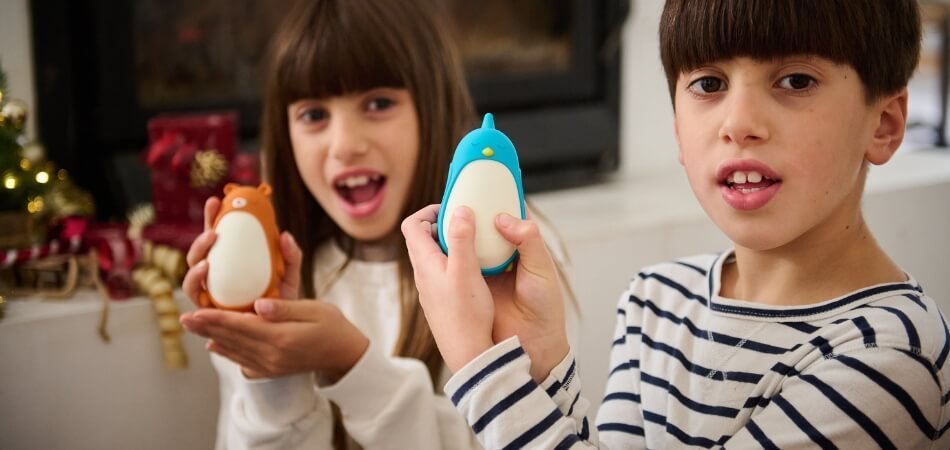
I can only go by what the offer page and the brand’s photos show here, so that’s what this section covers.
Animal Characters
The page says the sleeves make Moonbuddy “feel like their friend, not a device!” The two characters, a bear and a bird, are shown in orange and blue in the brand’s photos.
Designed Like A Toy
The FAQ says Moonbuddy “taps into what kids naturally love: cuddly companions,” and that children see it “as a friend rather than a chore.”
Small And Light
At 88 grams, per the page, it should be easy for small hands to hold and to carry in a school bag.
Soft Sleeves
The page says the sleeves are “made with child-safe materials and are easily swappable.” It doesn’t name the material.
A Companion, Not A Gadget
Being a companion, not a gadget, is the whole pitch. Whether your child takes to it is personal, which is why the 30-day window matters.
Key Features to Look For
These are the features the offer page lists:
- Tactile breathing guidance: the device expands and contracts so a child can breathe along.
- Four breathing patterns: “Developed by the Moonbird team with patterns for different ages and calming needs.”
- One button: “No apps to navigate, passwords to remember.”
- Automatic 4-minute sessions: it “turns off automatically after completing the scientifically proven cycle.”
- No screens or wireless: “no blue light, WiFi, or Bluetooth signals.”
- USB-C charging: “holds enough power for multiple sessions on a single charge.”
- Swappable sleeves: bear or bird.
What Parents Report Over Time
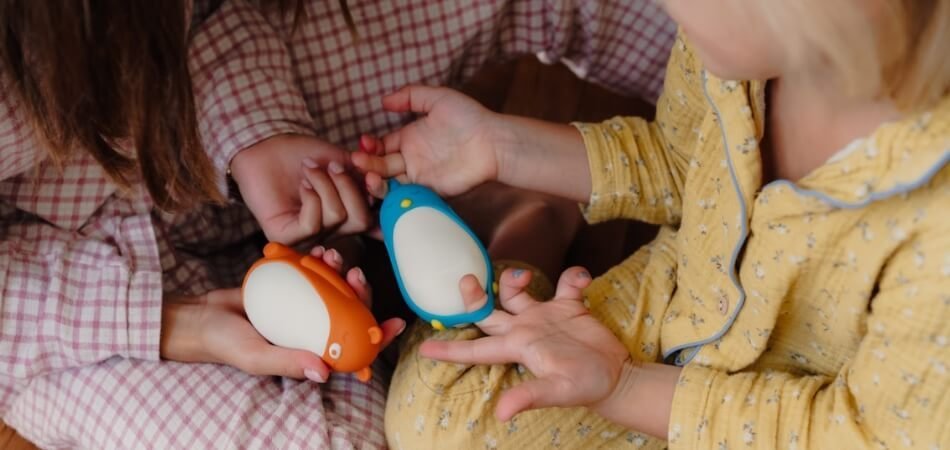
For how it holds up over weeks, the best I have is what buyers wrote, so this section leans on them.
Getting Kids To Try It
The FAQ says “Parents consistently report that kids ask for their Moonbuddy at bedtime.” That’s the brand’s summary of feedback, not a study.
Using It Without Help
The page says “Kids can use it independently anytime, anywhere.” One button makes that plausible for school-age kids.
Part Of A Routine
On the offer page, Antonia wrote that their 9-year-old, who has anxiety at bedtime, got one “a few weeks ago and it has made a huge difference in her nighttime routine!”
Calming Down When Upset
Lauren C. wrote that their 12-year-old “really values his Moonbuddy to help him calm down when he is upset and to relax when he is trying to fall asleep.”
At School And During Stress
Courtney J., a kindergarten teacher, wrote that “several students” use it “to regulate their breathing when they get upset or need a break in the classroom.” The same review notes, “A student broke the bear,” which is worth knowing for durability. Lise S. wrote that it helps “during the exams.”
Falling Asleep
The page’s claim is “4 Minutes.” I found no study of Moonbuddy itself, and the general sleep evidence is weak, as covered below.
Bedtime Arguments
The page says it “Reduces Stress & Arguments At Bedtime,” so the parent is no longer the bad guy at lights-out. Plenty of parents would like that, but how it goes will depend on the child.
A Note On These Reviews
These are seller-chosen reviews. On Trustpilot, most reviews are positive, but a few report devices that stopped inflating, which I cover below.
What The Research On Breathing For Kids Says
I think this is the most useful context for any parent considering Moonbuddy, because the page leans hard on science it doesn’t name.
Children And Relaxation Techniques
NCCIH says, “Some relaxation techniques may help children and adolescents with pain, anxiety and depression, headaches, or difficulty with needle-related procedures. But much of the supporting research was rated as low quality, so we don’t have a completely clear picture yet of the possible benefits.” That’s encouraging but cautious, and it’s about breathing practice in general, not this device.
Sleep
On sleep, NCCIH is clearer, though it’s citing adult guidelines from the American College of Physicians and gives no sleep finding for children. It says the guidelines “strongly recommend the use of cognitive behavioral therapy for insomnia (also called CBT-I) as the initial treatment for chronic insomnia,” and that “Relaxation techniques can sometimes be one part of CBT-I. But relaxation techniques on their own don’t seem to be especially promising for sleep.” So I’d expect Moonbuddy to help some kids wind down, not to fix real sleep problems.
Stress
NCCIH cites a review, not specific to children, with “preliminary evidence suggesting that diaphragmatic breathing exercises may help to reduce stress.” The offer page doesn’t say which breathing style Moonbuddy uses.
Safety
NCCIH says, “Relaxation techniques are generally considered safe for healthy people,” though “occasionally, people report negative experiences such as increased anxiety.” It adds that “There have been rare reports that certain relaxation techniques might cause or worsen symptoms in people with epilepsy or certain psychiatric conditions, or with a history of abuse or trauma.” If your child seems more upset during a session, I’d stop and try again another time.
Pros and Cons of Moonbuddy
Here’s how it balances out, from the offer page, NCCIH and the reviews I checked.
How Moonbuddy Works (Per The Offer Page)

Based on the offer page, here’s the process.
Step 1: Press One Button
The page describes “One-Button Simplicity.”
Step 2: Hold It In Both Hands
The brand’s photos show children holding it against their body or lap.
Step 3: It Expands And Contracts
The page calls this “tactile breathing guidance.”
Step 4: Breathe Along
The FAQ says it “teaches the correct pace and depth automatically, without requiring cognitive effort.”
Step 5: No Instructions To Remember
The page says there are no apps, passwords or setup.
Step 6: It Turns Off By Itself
After 4 minutes, the session ends automatically, per the page.
The 4-Minute Breathing Sessions Explained
Automatic 4-Minute Session Length
Each session runs four minutes. The page calls it a “scientifically proven cycle,” but doesn’t name the science.
Turns Off On Its Own
The FAQ says “the device automatically stops after 4 minutes to prevent overuse.”
Can Be Repeated
The FAQ says “Many families use Moonbuddy multiple times daily,” at bedtime, during homework stress or whenever a child needs to calm down.
Fits A Bedtime Routine
Four minutes is short enough to fit between a story and lights-out. NCCIH, citing adult guidelines, notes that cognitive behavioral therapy is the first treatment for chronic insomnia, so if sleep problems are serious, talk to your pediatrician.
Breathing Patterns and When They’re Useful?
Four Built-In Patterns
The page says there are “Four Expert-Designed Breathing Patterns” with “patterns for different ages and calming needs.” It doesn’t describe each pattern.
Slower Patterns For Deeper Calm
Slower patterns are the brand’s suggestion for deeper calm, and NCCIH’s stress review backs slow breathing, if only tentatively.
Options For Different Ages
The page mentions ages but gives no age range on the visible page. Check the manual before giving it to a very young child.
Nothing To Memorize
The FAQ’s point is that a child follows a physical cue instead of instructions, “like asking why training wheels help kids learn to ride bikes.”
Comparison With Similar Products
In general terms, these are the main calm-down options for kids:
How The Options Differ
| Option | How it works | Trade-off |
| Moonbuddy | Physical breathing cue in a child’s hands | $89.99; evidence for sleep is limited |
| Breathing or sleep apps | Audio or visual guidance | Usually needs a phone or tablet at bedtime |
| Parent-led breathing | Breathing together, counting or slow belly breathing | Free, but needs a calm adult at that moment |
| Professional support | Therapy for anxiety or sleep problems | Costs more, but can address the underlying issue |
What Makes Moonbuddy Stand Out
The physical cue and the toy design. A child doesn’t need to read, count or look at a screen. That’s the strongest argument for it over an app.
When An App Or A Parent Might Be Better
An app can offer stories, sounds and many more breathing exercises, often for less money, if you’re comfortable with a screen at bedtime. And a parent breathing slowly alongside a child gives a kind of comfort a device can’t copy. I’d see Moonbuddy as a middle option: more independent than a parent, less stimulating than a screen.
The Screen-Free Argument
The page says Moonbuddy avoids the “blue light, WiFi, or Bluetooth signals that suppress melatonin production and keep kids wired at bedtime.” That’s the brand’s explanation, and the page doesn’t cite a source for it. The practical point stands, though: one less screen in the bedroom is one less thing to argue about at lights-out.
Does Moonbuddy Teach Real Calm Skills or Just Temporary Relief?
The page claims it “teaches self-regulation techniques your child will use for life!” That’s the hope behind any breathing practice. NCCIH’s summary is more cautious: relaxation techniques may help children with anxiety and other issues, “But much of the supporting research was rated as low quality, so we don’t have a completely clear picture yet of the possible benefits.”
Learning Through Touch
The FAQ says kids “internalize these patterns” over time. That makes sense as a practice tool, though the page shows no follow-up study.
Less Dependence Over Time?
The page doesn’t say whether kids eventually stop needing it. Using it alongside teaching your child to breathe slowly without the device may help that skill transfer.
Useful Beyond Bedtime
One teacher and one reviewer describe using it for classroom breaks and exams.
The “Training Wheels” Idea
The FAQ’s analogy fits: a support a child leans on while learning, then needs less.
Children With ADHD Or Anxiety
The FAQ says it’s “particularly effective for children with attention or anxiety challenges.” That’s a strong claim with no study shown. For a diagnosed condition, it’s a comfort tool alongside the care your child’s doctor recommends, not a replacement.
Battery Life and Charging
The page says it uses “fast USB-C charging that holds enough power for multiple sessions on a single charge.” It doesn’t give the number of sessions or hours. A few Trustpilot reviewers of Moonbird’s devices mention battery and charging complaints, so check the warranty terms.
What Other Parents Seem to Be Saying?
I only quote reviews I could find myself, on the offer page and on Trustpilot.
On the offer page, the reviews are positive, from a reviewer using it for exam stress to a kindergarten teacher using it in class. On Trustpilot, Moonbird has a 4.7 TrustScore from 964 reviews on a profile claimed in December 2020, with 84% five-star and 3% one-star reviews. Reviewers including E Anthony and Klaudia Matwiej mention Moonbuddy by name.
The negative reviews are mostly about devices that stopped working and refund questions. Eugenia Horan wrote in October 2026, about a Moonbird unit (it isn’t clear which model), that “my unit is already failing to ‘inflate’ after 3 months.” A BBB search for “Moonbird” found no matching profile.
Pricing of Moonbuddy?

These are the prices on the offer page in November 2026:
- 1 Moonbuddy: $89.99, listed as $99.99, plus shipping.
- Buy 1, Get 1 50% Off: $149.99, listed as $199.98, with free shipping. About $75 each.
- Buy 2, Get 1 Free: $199.98, listed as $299.97, with free shipping. About $66.66 each.
The page also lists a “30-Day Money Back Guarantee” and, in its FAQ, “a 2-year warranty covering any defects.” It doesn’t say who pays return shipping, so read the Returns link at the bottom of the page.
Who Should Buy Moonbuddy, And Who Should Skip It
It suits:
- Kids who get wound up at bedtime and like cuddly toys.
- Families trying to keep screens out of the bedroom.
- Older kids and teens who want a quiet tool for exam stress, as Lise S. describes.
- Classrooms and calm-down corners, as Courtney J., a kindergarten teacher, describes.
I’d skip it, or check with a doctor first, if:
- Your child has a long-running sleep problem; NCCIH, citing adult guidelines, points to CBT-I as the first treatment for chronic insomnia, so ask your pediatrician.
- Your child has epilepsy, a psychiatric condition or a history of trauma; NCCIH notes rare reports that relaxation techniques “might cause or worsen symptoms” in those cases.
- Your child’s anxiety is affecting school or daily life; a breathing toy is a comfort aid, not a treatment.
- Your child has asthma or another breathing condition; ask your pediatrician about breathing exercises.
- A free routine of slow breathing together already works for your family.
Is Moonbuddy Worth The Money?
I think it depends on your child. For a kid who loves stuffed animals and struggles to settle, $89.99 for a screen-free tool your child is willing to pick up can be money well spent. For a child who won’t sit still with anything in their hands, it may end up in a drawer, and the 30-day guarantee is your safety net.
I’d also weigh it against free options. Breathing slowly together with a parent costs nothing and practices the same skill. What Moonbuddy adds is a physical cue a child can follow alone, without a parent in the room or a screen in hand. If that independence matters to you, the price makes more sense.
For two kids, the two-pack at about $75 each is the better deal, and it saves the sharing arguments.
Tips For Using It At Bedtime
None of these come from the offer page; they’re how I’d introduce any calming tool.
- Practice when calm. I’d try it in the daytime first, so it’s familiar before a hard night.
- Make it part of the routine. A set spot after the story and before lights-out helps it stick.
- Breathe along at first. Doing it together for the first few nights shows a child what to do.
- Keep it optional. I wouldn’t force it during a meltdown; offer it, then let the child choose.
- Watch the charge. A flat battery at bedtime defeats the point, so charge it in the daytime.
Is Moonbuddy Legit?
Yes. Moonbird is an established company with a claimed Trustpilot profile since December 2020, and a 4.7 TrustScore from 964 reviews covering all Moonbird products. Several of those reviews mention Moonbuddy by name. The weak points are marketing claims like “Backed by Mayo Clinic Science” with no source, and a few reports of units that stopped inflating, which the 2-year warranty should cover.
Questions To Ask Before You Order
- What ages is it for? The visible page doesn’t give a range.
- How many sessions per charge? The page says “multiple sessions” but no number.
- What are the four patterns? The page doesn’t describe them.
- Who pays return shipping? The guarantee text doesn’t say.
- Can you buy extra sleeves? The page says they’re swappable, but not whether they’re sold separately.
Where to Buy?
The offer page sells it directly, with a choice of “Barry The Bear” or “Bibi The Bird.” The page says it’s “Trusted by 80,000+ MoonBirdies” and “Rated 4.7 Stars,” and elsewhere “Trusted by Over 100,000 Families Worldwide,” which don’t quite match.
If you have two children, the two-pack brings the price down, and avoids arguments over whose turn it is. Since the sleeves come as a bear and a bird, each child can pick a character, which may help each one feel it’s really theirs rather than a shared gadget.
Claims Vs What I Found
| Claim | What I found |
| “Fall Asleep In Just 4 Minutes” | No study of Moonbuddy shown. NCCIH: relaxation alone isn’t “especially promising for sleep.” |
| “Scientifically Proven” | NCCIH says much of the research on kids is “low quality.” |
| “Backed by Mayo Clinic Science” | No Mayo Clinic source named or linked. |
| “particularly effective for children with attention or anxiety challenges” | No study shown. |
| “80,000+” and “Over 100,000 Families” | The two figures on the same page don’t match. |
I checked these on the offer page, NCCIH, Trustpilot and the BBB in November 2026.
Frequently Asked Questions
These are the questions I’d want answered before ordering, with what the offer page and NCCIH say.
Can Siblings Share A Moonbuddy?
They can take turns, but the sleeves suggest each child is meant to have their own character. The two-pack is cheaper per unit.
Is Moonbuddy Suitable For Very Young Children?
The visible page doesn’t give an age range. A kindergarten teacher uses it in class, per the reviews. Check the manual before giving it to a toddler, and stay close the first few times.
Does Moonbuddy Make Noise?
The page says teachers like it because it’s “quiet, non-disruptive.” It doesn’t give a noise level.
Can It Help During Meltdowns?
The page says it’s for “Emergency Calm-Down” moments too. During a full meltdown, a child may not want to hold anything; it may work better as a habit practiced when calm.
How Long Until Kids Get Comfortable With It?
The page doesn’t say. One review describes “a huge difference” within “a few weeks.”
Can Teenagers Use It?
Older kids can, according to the reviews. Lise S. wrote that “it works perfect during the exams,” and Lauren C. described a 12-year-old who uses it to calm down and fall asleep.
Is It Easy To Clean?
The page lists “Easy to Clean” and says the sleeves are “easily swappable.” It doesn’t give washing instructions, so check the manual before putting a sleeve in the wash.
What If It Stops Inflating?
The FAQ says it “comes with a 2-year warranty covering any defects.” A few Trustpilot reviewers of Moonbird devices report this problem, though it isn’t always clear which device, so keep your order details.
Does It Need An App Or Wi-Fi?
No. The page says there’s “no blue light, WiFi, or Bluetooth,” and “No apps to navigate.”
Is It Good For Travel?
The page calls it “Portable Enough for School, Travel & Emergency Calm-Down” and says it weighs 88 grams. Bring the USB-C cable on longer trips.
Is It Safe Every Night?
The FAQ says “Absolutely!” and that it uses “no medication, chemicals, or artificial substances.” For a child with a breathing condition such as asthma, ask your pediatrician first.
Final Verdict
Yes, if you want a screen-free, toy-like breathing guide to build a calmer bedtime routine and your child likes the idea of a cuddly companion. I gave Moonbuddy 8.0 out of 10 for its one-button design, automatic sessions, no-screen approach, Moonbird’s strong Trustpilot record, 30-day guarantee and 2-year warranty. It isn’t higher because its “4 minutes” and “scientifically proven” claims overstate the evidence, much of the research on kids was rated low quality, per NCCIH, and it costs $89.99 for one. For ongoing sleep or anxiety problems, talk to your pediatrician.


