
Disclosure: This review contains affiliate links. I may earn a commission if you buy through them, at no extra cost to you. Written by Michael Montoya. Last updated: November 8, 2026.
TV volume is a common household argument. Action scenes blast, quiet dialogue gets buried, and the person who needs it louder ends up reaching for the remote all evening while everyone else winces.
The HearDirect Wireless TV Headset is a personal TV listener from Hear Direct Club, a company that also sells hearing aids. Its offer page headline is “Stop Arguing Over The TV Volume!” The page also makes big claims, so I wanted to see what the product really is, how it connects, what it costs, and how the company handles returns.
For this HearDirect review, I went through the offer page and its order data, the brand’s own store and refund policy, its sales article, NIDCD guidance on hearing loss, Trustpilot, and BBB.

A wireless TV listener with an under-chin headset and a transmitter on your TV, so one person sets their own volume. Useful for shared rooms; not a hearing aid.
- Own volume for one person, room stays quiet
- Under-chin fit, nothing on glasses
- Dedicated 2.4GHz link, no pairing
- $79.99, less than the brand store
- Not a hearing aid
- Return window stated as 100 and 30 days
- Many refund-delay complaints on Trustpilot
- Survey claims have no source
Quick Verdict
HearDirect makes sense if one person in the house needs the TV louder or clearer and everyone else wants it quieter. The headset gets its own wireless feed from the TV, so the wearer sets their own volume. At $79.99 on the offer page, it’s cheaper than the same style on the brand’s own store. The catches: it isn’t a hearing aid, the offer page’s return terms aren’t consistent, and Hear Direct Club’s Trustpilot page scores 3.2, with 45% one-star reviews, including refund-delay complaints. If you buy one, test it with your TV in the first week.
What Is HearDirect Wireless TV Headset?
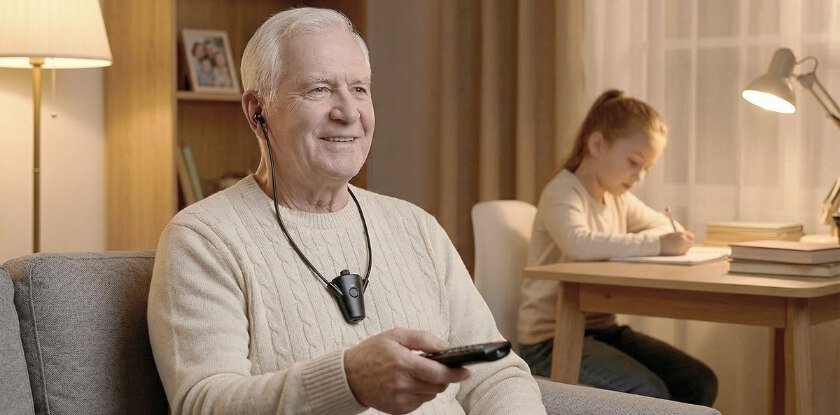
It’s a wireless TV listening system: a small transmitter that plugs into your TV’s audio output, and a headset that receives that sound. The product in the brand’s photos is an under-chin style, with ear tips on a band that hangs below the chin and a control pod in the middle.
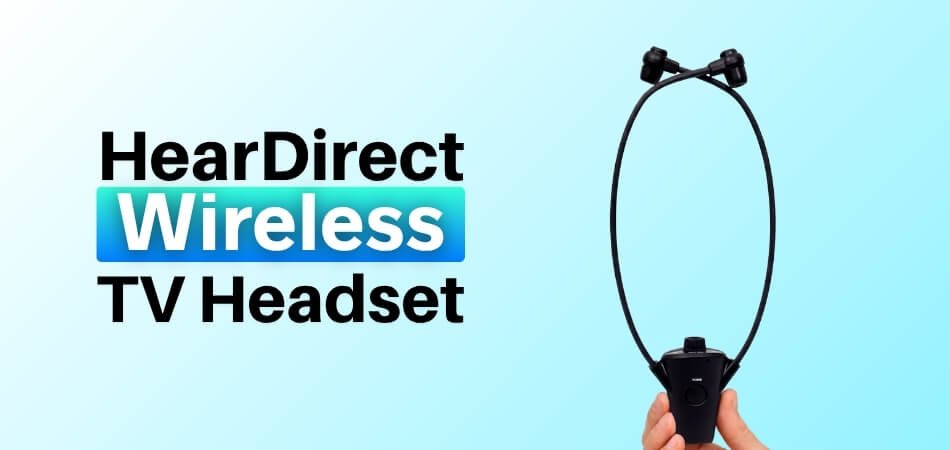
The brand’s store sells what looks like the same design under the name “HearClear TV Headset.” Its listing describes “featherlight in-ear tips on a soft under-chin band: no headband over your hair, nothing pressing on glasses.” It also says plainly, “This is a TV-listening device, not a hearing aid, so anyone in the house can use it.”
That’s the right way to think about it. It brings the TV’s sound to your ears at your own level. It doesn’t test, correct, or treat hearing loss.
Why People Look at HearDirect
Most people come to a product like this for one of three reasons.
The first is dialogue. TV sound mixes often put voices under music and effects, so speech gets lost at normal volume. The offer page promises you can “finally turn off those annoying subtitles.” That’s a strong claim; captions help many people, and I’d keep them as an option.
The second is shared rooms. If one person needs the TV loud and another doesn’t, a personal headset lets each choose. The brand calls this its main point: “Enjoy The Perfect Volume For YOU – Without Disturbing Anyone.”
The third is late-night watching, when you don’t want the TV to carry through the house. A headset fixes that for anyone, with or without hearing trouble.
If you recognize your home in any of these, the idea fits. Whether this particular model is the one to buy comes down to setup, comfort, and the seller.
What Matters When Choosing a TV Headset Like HearDirect
Since this is a TV listener, the questions that matter are practical ones, and I answered them from the brand’s pages and order data.
I also read NIDCD guidance about hearing loss, so the page doesn’t oversell what a headset can do.
The main things I wanted answered were:
- Which TV connections it supports
- Whether it uses Bluetooth or its own wireless link
- How long a charge lasts
- What it costs on the offer page versus the brand’s store
- Which return policy actually applies
- Who it suits, and who needs something else
I didn’t judge it as music headphones or as a hearing aid, because it’s neither.
Setup And Ease Of Use
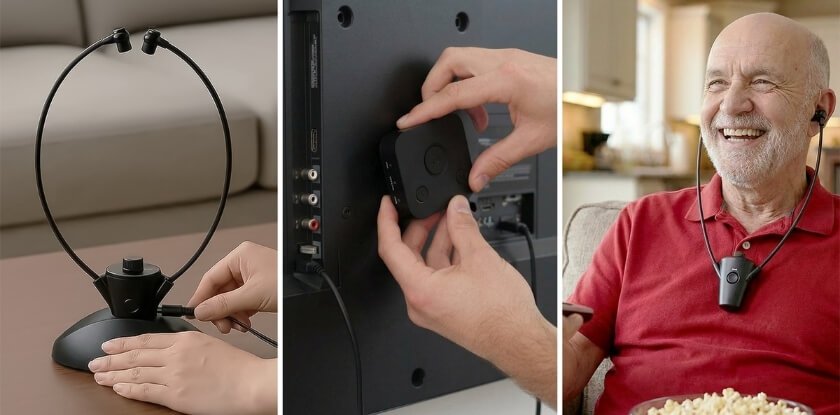
The brand’s store listing gives the clearest setup description. It says “The charging base is also the transmitter. It plugs into the back of your TV (optical and 3.5mm connections both covered).” The sales article adds that it works with TVs that have “Optical Audio, Line Out Audio, or Coax Audio.”
No app or Bluetooth pairing is involved.
What setup involves, per the brand:
- Plug the transmitter into your TV’s optical or 3.5mm output
- Plug in the power adapter
- Lift the headset off its stand and set your volume
- Set it back on the base to recharge
The offer page says it “works on 99% of TVs,” which I can’t check. One practical point: on some TVs, using the headphone or optical output changes what the TV speakers do, so look in your TV’s sound settings if the room goes quiet when the headset is connected. The brand says its support “will help you get connected to your exact TV.”
Sound Quality And Dialogue Clarity
Sound is what most buyers care about. The offer page promises “state-of-the-art background noise cancellation” and “Crystal-Clear Surround Sound,” and says it “Amplifies Quiet Sounds” with “Automatic sound adjustment.”

The offer page also lists survey-style figures, such as “96% say dialogue is clearer at normal volume.” It doesn’t say who was surveyed, how many people, or how. I’d treat those as marketing until a source is shown.
What’s realistic? In general, sound sent straight to your ears at your own volume tends to be easier to follow than room speakers, especially for dialogue. The store listing mentions “Volume and tone controls” on the headset, which can help bring voices forward. Whether that’s enough for you depends on your hearing and your TV’s sound.
Where a TV headset tends to help most:
- scenes with soft voices under music
- news, interviews, and dramas with lots of talking
- late-night viewing when the room needs to stay quiet
- rooms where one person needs it louder than everyone else
I wouldn’t buy it for music. The brand markets it for TV dialogue, not music.
Does HearDirect Have Audio Lag?
The brand says no. The store listing says “Dedicated 2.4GHz wireless keeps the sound perfectly in sync with the picture: no lip-sync delay, no pairing menus, no app.” The offer page lists “No Audio Lag” and “Lips & Voices Always In Sync.”
That’s a reasonable design choice. A dedicated TV transmitter avoids the pairing problems many people have with Bluetooth headphones and TVs. I found no independent lag test, so I’d check sync with a talk show in your first days, while returns are still easy.
Personal Volume Control
Separate volume is the main reason to buy any TV headset, and it’s the brand’s main pitch. The offer page describes a setup that “Splits Your Audio For Personal Volume Levels.”
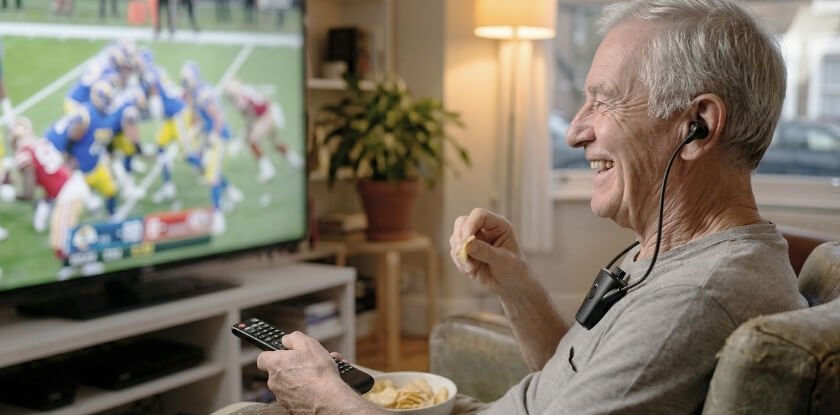
In practice, the wearer turns the headset up while the TV speakers stay at a level the room likes. The store listing says the controls “sit right on the headset, so you can adjust everything with your thumb without touching the TV remote.”
That helps most when:
- one person needs the TV louder than others
- you watch late at night
- dialogue keeps getting lost under effects
- you want to stop handing the remote back and forth
If the room speakers go quiet when the headset is on, the setup section’s TV settings note applies.
Comfort And Fit
Comfort matters because you’d wear it for a whole episode or a film. It’s under-chin, not over-ear, which helps glasses wearers and anyone who dislikes a band over their hair.
The store listing says it sits on a “soft under-chin band” with “featherlight in-ear tips,” and that there’s “nothing pressing on glasses.” That’s a real plus for glasses wearers, and for anyone who doesn’t like a band over their hair.
A few things to know:
- In-ear tips go into the ear opening, which some people find less comfortable than cushions.
- The offer page text talks about “Soft, breathable ear pads,” which sounds like an over-ear model. The brand’s store sells an over-ear version separately, so check which one your package shows before you order.
- If you share it, clean the tips between users.
Comfort is personal, so wear it through a full show before deciding.
Battery Life And Charging
The offer page lists “One Charge Lasts 8+ Hours!” and the sales article says “One full charge gives you 8+ hours of uninterrupted listening.” Both of those pages also describe “ear pads” and an “adjustable headband,” which sounds like an over-ear model. The brand store’s listing for the under-chin headset gives no battery figure, and its over-ear model says “about 12 hours.” So I’d treat 8 hours as a rough guide and ask support which figure fits the model you order.
Charging is simple by design. The store listing says, “Set it back on the base afterward and it recharges, always topped up and always where you left it.” That suits a TV routine, since the headset lives next to the TV anyway.
Eight hours covers a long evening. If you watch all day, you’d need to dock it at some point. The brand gives no figure for how long the battery keeps that capacity over years.
HearDirect Pros And Cons
HearDirect is easiest to judge as a TV listening tool. The strengths are the idea and the setup; the weak spots are the seller’s record and the marketing.
The idea is sound. I’d weigh the company’s refund record before buying more than one.
HearDirect Wireless TV Headset Vs Regular Bluetooth Headphones
Regular Bluetooth headphones can work with a TV, but they aren’t built for it. The brand’s sales article puts it this way: “It uses dedicated wireless technology specifically designed for TVs – not repurposed Bluetooth.”
Here’s how the two compare, using the brand’s listed features and general facts about Bluetooth headphones.
| Feature | HearDirect (brand claims) | Regular Bluetooth Headphones |
| Main purpose | TV listening | Music, calls, travel, and general use |
| Connection | Transmitter on the TV’s optical or 3.5mm output | Needs a TV with Bluetooth, or an adapter |
| Pairing | “no pairing menus, no app” | Pairing through the TV’s menus |
| Audio sync | “no lip-sync delay,” per the brand | Can lag on some TVs |
| Style | Under-chin with in-ear tips | Over-ear or earbuds |
| Charging | Docks on its base | Cable or case |
If your TV already has Bluetooth and you own good headphones, try them first; it costs nothing. If pairing, lag, or glasses are a problem, a dedicated TV headset like this is the simpler setup.
Is HearDirect Good For Seniors?
It can be, with one important point first. Trouble hearing the TV is common with age. NIDCD, part of the National Institutes of Health, says “about one in three people in the U.S. between the ages of 65 and 74 has hearing loss.”
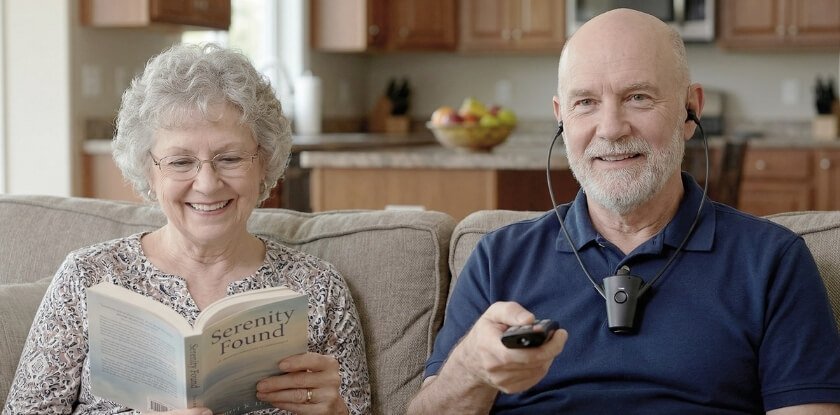
NIDCD lists “Does a hearing problem cause you difficulty when listening to TV or radio?” among its screening questions. If the answer is yes, a TV headset helps with the TV, but it doesn’t address the hearing problem itself. NIDCD’s advice is to “Start by learning more about hearing loss,” to consider over-the-counter hearing aids depending on your symptoms (a category for adults with mild to moderate loss), and to see a hearing health professional when that isn’t enough. It describes primary care doctors, ENTs, and audiologists as the people who can help.
So for a senior, I’d see it as a comfort tool for TV time, ideally alongside a hearing check. The under-chin style and dock charging make it easier to live with than earbuds that need a case. The brand also says its “Hearing Experts” can help by email, chat, or text.
Who Should Buy HearDirect Wireless TV Headset?
It suits households where the TV volume is a daily friction point.
You’ll get the most from it when voices get lost or one person needs it louder.
HearDirect is a good fit if you:
- share a TV with someone who wants it quieter
- watch late at night
- wear glasses and dislike over-ear headphones
- want a setup with no app or Bluetooth pairing
- have a TV with an optical or 3.5mm audio output
On paper, it fits that job.
Who Should Skip HearDirect?
Skip it if you mainly want headphones for music, calls, or travel; it’s built around TV listening.
Skip it, too, if you suspect hearing loss and hope this will fix it. A headset won’t, and NIDCD’s guidance points to learning about hearing loss, OTC hearing aids, and hearing professionals. And if you dislike anything in your ears, the in-ear tips may bother you; the brand’s over-ear model or room speakers might suit you better.
Finally, if a slow refund would be a serious problem for you, read the company’s Trustpilot reviews before ordering.
HearDirect Price And Buying Details
On November 8, 2026, the offer page data listed three packages.
| Package | Offer price | Offer page “was” price | Per headset |
| 1 headset | $79.99 | $89.99 | $79.99 |
| Buy 1, Get 1 50% OFF (2 headsets) | $134.99 | $179.98 | about $67.50 |
| Buy 2, Get 1 FREE (3 headsets) | $179.98 | $269.97 | $59.99 |
The order data showed free shipping. For comparison, the brand’s own store listed the HearClear TV Headset at $129.00 (normally $189.00), so the offer page was the cheaper place to buy that day.
I’d start with one. Two makes sense if two people in the house would use it.
Where To Buy HearDirect Wireless TV Headset
My links go to the HearDirect offer page. It says, “Purchasing here is buying directly from Hear Direct Club.” The brand’s own store sells the same style for more.
The return terms are where I’d slow down. The offer page shows a “100-DAY MONEY BACK WARRANTY” and says “Love it or your money back, no questions asked!” Its order data, though, lists a 30-day return window with a return required before any refund. The brand’s store listing for this headset says “Try it for 100 days from the day it arrives. If it is not right for you, send it back for a full refund.” The store’s general refund policy also says “We have a 100-day return policy,” though its wording is about hearing aids. It says support will send a shipping label, but it also says “You are responsible for paying return shipping fees” and “Returns without prior approval will not be accepted.”
So the brand says 100 days in three places and the order data says 30. I’d plan on 30 to be safe, and email hello@heardirectclub.com to confirm the window for an offer-page order before you buy.
What Users Are Saying About HearDirect
Here’s what I could verify, with each quote labeled by where it came from.
Hear Direct Club’s Trustpilot page, checked November 8, 2026, shows a TrustScore of 3.2 from 264 reviews: 51% five stars and 45% one star. The reviews I read are about its hearing aids, not the TV headset. I found no Trustpilot page for getheardirect.com and no BBB listing for Hear Direct Club. The offer page shows its own buyer quotes, which are the brand’s picks.
Two happy buyers, from the offer page:
Nadia W. wrote, “I didn’t realize how much I was missing until I tried these.”
Robert F. wrote, “My TV watching experience has never been better.”
And one positive note on Trustpilot about support:
Robert Schoenburg wrote in November 2026, “Questions answered in a timely manner.”
The complaints worth reading:
Mike Rone wrote in October 2026, “Weeks upon weeks of delayed delivery and week after week of delayed refund.” Brent Bell wrote in November 2026, “They take your money and essentially refuse to refund it” Those are about the company’s orders in general, but they’re the same company you’d be buying from.
HearDirect Claims Vs What I Found
| Claim | What I found | Where I checked |
| “works on 99% of TVs” | It needs an optical or 3.5mm output (the sales article adds coax). Most TVs have one, but no source for 99%. | Offer page, store listing, sales article |
| “96% say dialogue is clearer at normal volume” | No survey size, method, or source given. | Offer page |
| “It’s a must-have for couples, families, and anyone hard of hearing!” | The brand’s own store says it’s “not a hearing aid.” NIDCD lists TV listening trouble among its hearing screening questions. | Offer page, store listing, NIDCD |
| “No Audio Lag” | A dedicated 2.4GHz link supports the claim on paper; no independent test. | Offer page, store listing |
| “100-DAY MONEY BACK WARRANTY” | The offer’s order data says 30 days, with the item returned first. | Offer page and its data |
FAQs About HearDirect Wireless TV Headset
These are the smaller questions I’d want answered, from what the brand publishes plus common sense.
Can You Still Watch TV Normally With Someone Who Isn’t Using HearDirect?
Usually, yes; that’s the point of it. The headset gets its own feed while the room listens to the TV speakers. Some TVs turn off their speakers when an output is in use, so check your TV’s sound settings if that happens.
Does HearDirect Work Better For Certain Types Of TV Shows?
A personal headset helps most with talk-heavy shows like news, dramas, and interviews, where voices matter. Action scenes can help too, when effects drown out voices.
Will HearDirect Help If Your TV Speakers Are Poor?
It may, since the sound goes to your ears instead of through thin TV speakers. If your issue is hearing itself, NIDCD’s hearing loss page is a good place to start.
Can You Use HearDirect Every Day?
Yes. The offer page lists 8+ hours per charge, and the under-chin model recharges on its base between uses. Clean the ear tips regularly, especially if more than one person uses it.
Is HearDirect Worth Buying If You Already Have A Soundbar?
Only if one person needs a different volume than the room. A soundbar improves sound for everyone; a headset gives one person their own level.
Is HearDirect A Hearing Aid?
No. The brand’s own store says, “This is a TV-listening device, not a hearing aid.” For hearing loss, NIDCD lists over-the-counter hearing aids for mild to moderate loss and professional help for more.
What TV Connections Does HearDirect Need?
An optical or 3.5mm audio output, per the store listing; the sales article also mentions coax, but no coax cable is listed in the box. Check the back of your TV before ordering.
Final Verdict: Is It Worth the Money?
Yes, if one person in your home needs the TV louder or clearer and you want a setup with no app and no Bluetooth pairing. I gave it 8.0 out of 10 overall for the sensible design, the glasses-friendly fit, and a lower price than the brand’s own store. It isn’t higher because it isn’t a hearing aid, the survey figures have no source, the return window is stated two ways, and the company’s Trustpilot page has 45% one-star reviews, including refund complaints. Start with one, check it against your TV and your ears early, and keep your order email.


